The fungi, roots, bacteria, and animals living in the soil depend on having adequate water to survive and perform their “jobs” of recycling nutrients and improving soil structure. In a dry growing season, biological binding agents like roots, microbial glues, and fungal hyphae break down without an environment that protects them from drought, reducing soil structural stability. Microbes’ ability to mineralize nutrients declines, which can negatively affect plant growth. It may not be just temporary – drought can leave a legacy effect of persistent changes in microbial community composition and activity. However, much of the long term research about legacy impacts of drought on soil biology has taken place in grasslands, and more work is needed to understand if there are lasting impacts specifically to productivity.
Repeated dry periods can also leave the soil profile with a water deficit. A rain may wet the surface and improve conditions temporarily, while deeper layers remain dry. Recharging that deeper soil water can take multiple rainfall events or a prolonged wet period, particularly in areas with compaction and/or poor soil structure.
ST. PAUL, Minn. — Drought has defined five of the last six growing seasons in Minnesota, with below-normal precipitation and above-normal temperatures contributing to the spread of D1, D2, and D3 drought conditions across more than 75% of the state this summer. August is normally one of Minnesota’s wettest months, but rainfall totals have continued to fall short. Drought is expected to persist in much of the state through the end of the growing season. While impacts on corn yield are expected to be minimal across much of the state, seeing fields across the state recently had us wondering – beyond looking dry and cracked, what happens to our soils during a drought?
Drought and soil health
Healthy, productive soils have good soil structure, can cycle nutrients, can filter and retain water, are easily penetrated by plant roots, and support a variety of organisms living in them. Large soil pores, organic matter, and diverse soil microbiota are critical to functioning soils (see Figure 1 below). Drought affects all of these.
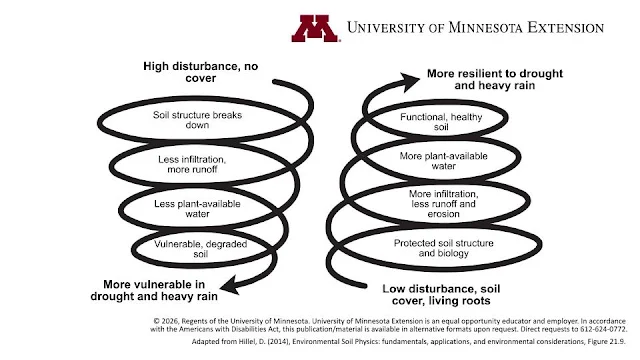
Water movement through soil is heavily dependent on good soil structure. When rain does come, extremely dry soils may become water-repellent, causing heavy rains to run off instead of soaking in. Shrinkage cracks and other large, connected pores can become the easiest pathways for incoming water, but if there’s not good connectivity between those cracks and the rest of the soil, water may travel quickly through these pathways and bypass much of the surrounding soil matrix, leaving some areas relatively dry. Cracking can increase evaporation of water under high temperatures, but over the long-term, lots of living roots and fungal hyphae will leave behind a well-connected soil pore network; even when cracking occurs and water rushes into very dry soils, those cracks will be better able to channel water to a larger volume of your soil profile.
Some areas of Minnesota have received large amounts of rain in a short period this summer. Drought risk depends not only on how much rain falls, but on how much water enters the soil and is stored within the crop rooting zone. Although weather changes from season to season, research by the University of Minnesota Climate Adaptation Partnership projects that farmers should prepare for longer stretches without precipitation, drier summers, and more intense precipitation in future summers. The trend we’ve already experienced of swings between wet and dry conditions over recent growing seasons is also expected to continue and intensify in the future, making readiness for dry conditions key to maintaining resilient farms.
What to do to reduce drought’s impacts
Through effective soil management, farmers can better prepare for and buffer these conditions.
Building and maintaining soil organic matter is one way to improve drought resilience because organic matter influences soil structure, pore space, and how much water soils can store and have available to plants. However, no single practice creates drought resilience on its own.
- Crop rotations: Multiple Midwest studies show that incorporating a small grainor cover crop into your rotation can reduce yield losses during drought. Diverse root systems from varied plant species can increase soil organic matter and, in turn, lower crop water stress by improving soil structure, rooting, and the soil’s ability to store and supply water.
- Reduced tillage: While tillage initially creates “fluffy” structure, this structure is not stable and breaks down over time. Loose particles are more easily eroded by wind and water, carrying organic matter and nutrients away from your field. Loose particles can also clog pores at the soil surface, forming a seal that can harden into a crust and block water from entering the root zone. Tillage can also create a plow pan, restricting root growth, water entry, and access to nutrients. Roots and hyphae create pore networks, and reducing tillagepreserves these for future water and root access.
- Residue: Residue reduces the amount of wind and solar radiation that reaches the soil surface, lowering evaporation. In addition, residue can help capture snowfall, which helps replenish depleted topsoil moisture levels. Residue will also be broken down by soil organisms as a food source in soils with healthy biological activity. These organisms also create soil pores and structure, allowing water and air entry.
These practices, in addition to reducing your field’s vulnerability to drought, can also improve nutrient efficiency, biological activity, and crop productivity. Importantly, these management practices are most effective at reducing your field’s vulnerability when used in combination, rather than as a single practice.
A University of Minnesota study in southern Minnesota measured soil structure stability and moisture levels in the 2021 and 2022 growing seasons, and fields using soil health management practices retained better soil structure and had more plant-available water, especially the field that integrated multiple soil health practices for the longest time.

Over the years, we’ve seen drought occur again and again, and we will see drought in future growing seasons. Planning for the future can reduce drought’s impact on your fields, crops, and watershed. It is unresolved whether all droughts negatively impact soil, but preparing for drought can help you advance your soil health goals.
Learn more about what to do to reduce drought’s impacts on soil health at mosh.umn.edu.